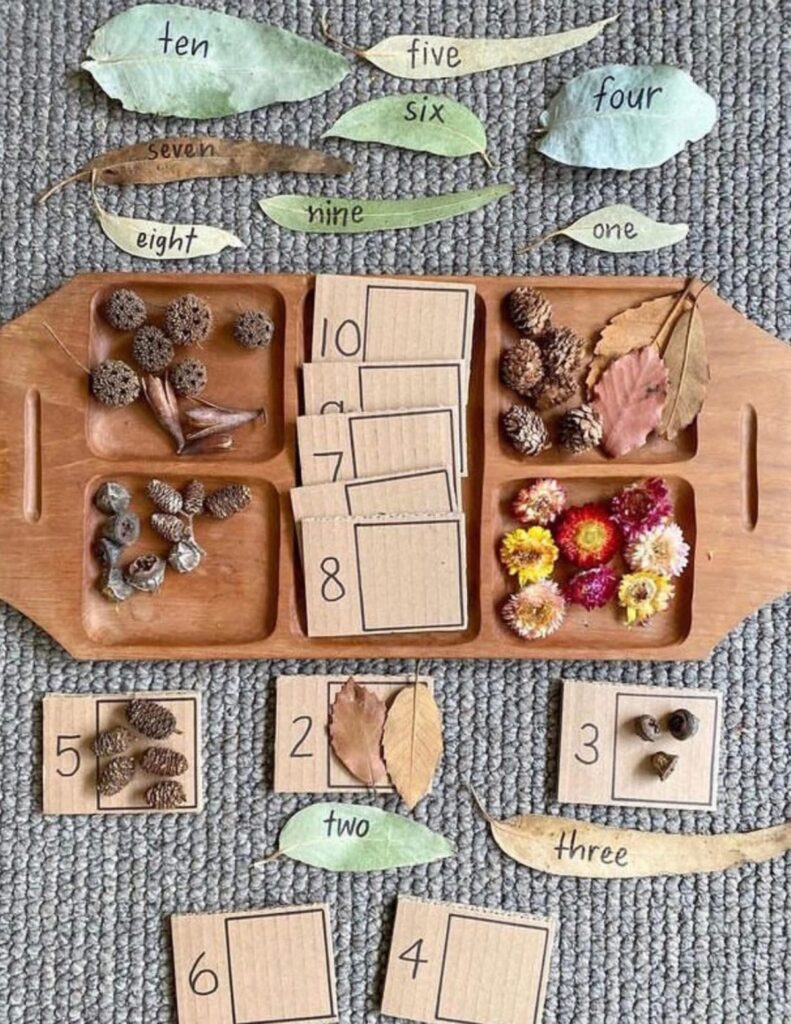
Loose parts play” is a concept in early childhood education and play theory. It emphasizes open-ended, unstructured play using materials that children can move, manipulate, combine, and experiment with in many ways. Unlike fixed toys that have a set purpose (like a puzzle or doll), loose parts encourage creativity, problem-solving, and exploration because the child decides how to use them.
What Are Loose Parts?
Loose parts are materials that can be moved, carried, combined, redesigned, lined up, and taken apart and put back together in multiple ways. They can be natural or man-made, including:
- Natural materials: sticks, stones, pinecones, shells, leaves, acorns, sand, water.
- Recycled or household items: cardboard tubes, bottle caps, fabric scraps, buttons, wooden blocks, jars.
- Art materials: beads, feathers, yarn, clay, pebbles, shells.
- Outdoor materials: tires, planks, crates, ropes, logs.
Benefits of Loose Parts Play

- Creativity & Imagination: Kids invent new ways to use materials, creating stories, structures, or games.
- Problem-Solving: Figuring out how to balance, build, or make something work develops reasoning skills.
- Fine & Gross Motor Skills: Manipulating small objects strengthens hand-eye coordination, stacking and building improves motor control.
- Cognitive Development: Encourages exploration, experimentation, and cause-effect understanding.
- Social Skills: Playing together encourages collaboration, negotiation, and communication.
- Emotional Development: Open-ended play allows children to express feelings, test boundaries, and build confidence
- Imagination & Creativity: Open-ended building, pretend play, storytelling
- Emotional Regulation: Calm sensory activities like sand or water play can reduce stress
- Language Skills: Discuss textures, colors, and actions (“soft,” “rough,” “pour,” “stack”
- Encourage storytelling and exploration and building.
- Combine indoors and outdoors for different sensory experiences.
What to use loose parts for
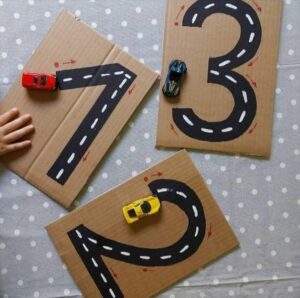
Loose parts are incredibly versatileonce you start thinking creatively, you can use them for almost every area of learning and play. Loose parts are perfect for hands-on learning because they turn abstract concepts like letters, numbers, and names into something children can touch, move, and experiment with.
1. Math & Logic
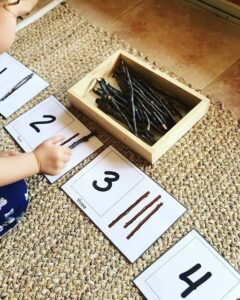
- Counting, sorting, and matching objects by color, shape, or size
- Making patterns and sequences (e.g., stone–leaf–stone–leaf)
- Building number lines or counting towers
- Measuring: comparing lengths with sticks, strings, or ribbons
- Graphing: use beans, buttons, or pebbles to create bar graphs
- Sorting coins or tokens by value or size
2. Literacy & Language
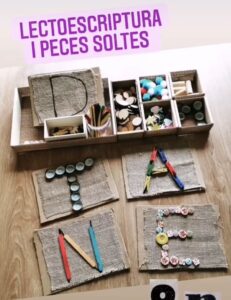
- Forming letters with sticks, yarn, or bottle caps
- Spelling names or simple words using small objects or wooden letters
- Alphabet hunts in a sensory bin
- Creating story prompts: use small figurines, animals, or objects to inspire storytelling
- Word building: match letter cards with loose parts as “holders” for each letter
3. Science & Nature Exploration
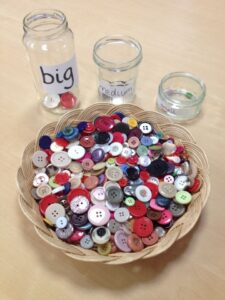
- Sorting leaves, rocks, seeds, or shells by type or color
- Observing textures, sizes, and weights of natural materials
- Creating a small ecosystem in a tray: water, stones, plants, and toy animals
- Experimenting with water flow using funnels, tubes, or bottles
- Planting seeds or small sprouts in loose soil containers
4. Art & Creativity
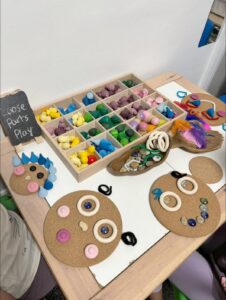
- Collages with leaves, flowers, feathers, or fabric
- Mandalas with stones, shells, and beads
- Painting rocks, sticks, or wooden shapes
- Threading beads to make jewelry
- Sculpting with clay, sand, or mud
- Nature printing: leaves or flowers dipped in paint and pressed onto paper
5. Motor Skills & Physical Play
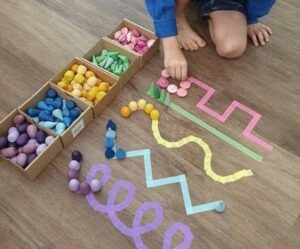
- Stacking stones or blocks to improve hand-eye coordination
- Building obstacle courses with crates, planks, or tires
- Balancing activities: walking along planks or logs
- Fine motor practice: picking up small objects with tweezers or fingers
- Pouring and transferring materials (sand, beans, water) between containers
6. Sensory & Cognitive Play
- Sensory bins with sand, rice, water, or beans and hidden objects
- Texture exploration: rough stones, soft feathers, smooth shells
- Sorting by size, weight, color, or texture
- Cause-and-effect experiments: tipping containers, rolling balls, stacking
- Matching games: pairs of shells, stones, or buttons
7. Imaginative & Role Play
- Building houses, castles, roads, or bridges with sticks, stones, and boxes
- Pretend kitchens: crates, spoons, leaves as food
- Small world play: animals, trees, stones recreate Bible stories or farm scenes
- Fairy or garden villages with natural materials
- Storytelling: use loose parts as characters or props
8. Faith & Bible-Inspired Play
- Creating Noah’s Ark scenes with animal figurines and blocks
- Making “loaves and fishes” with stones or beans
- Forming crosses with sticks or ribbons
- Acting out parables with loose parts: e.g., Good Samaritan, David & Goliath
- Prayer corners: arranging candles, flowers, or small tokens for reflection
Counting
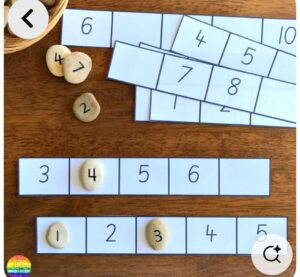
Loose parts to use: stones, buttons, shells, acorns, bottle caps, beads, pinecones.
Activities:
Place a number card (1–10) and ask the child to match that number of loose parts.
Make groups: “Put 3 stones here, 5 buttons there.”
Line them up to make a number line.
Stack loose parts to see quantities grow visually.
Learning outcome: strengthens one-to-one correspondence, early number sense, and fine motor skills.
Number Recognition & Learning
Loose parts to use: number cards, sticks, yarn, small toys, stones.
Activities:
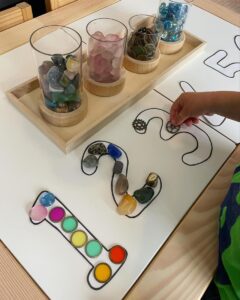
Place loose parts to form shapes of numbers (e.g., 3 sticks for the number 3).
Match loose parts to printed numbers.
Create a sensory number tray: write numbers in sand or salt and trace with fingers, then place loose parts to match.
Learning outcome: helps children recognize symbols, associate numbers with quantities, and understand sequences.
Alphabet & Letter Learning
Loose parts to use: buttons, pebbles, yarn, sticks, bottle caps, beads.
Activities:
Shape letters with sticks, yarn, or string.
Use small objects to form the outline of letters on a tray or table.
Play letter hunts: hide letters in a sensory bin of loose parts.
Match loose parts to letter cards.
Learning outcome: develops letter recognition, fine motor skills, and early literacy readiness.
Name Spelling
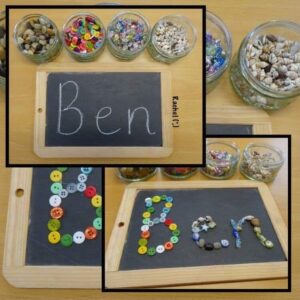
Loose parts to use: beads, stones, shells, buttons, bottle caps, wooden letters.
Activities:
Form letters of the child’s name with loose parts.
Make a name puzzle: separate letters, and ask the child to reconstruct their name.
Decorate each letter of the name with different loose parts.
Learning outcome: reinforces letter recognition, sequencing, and personal identity, while making learning tactile and memorable.
Sensory play
Touch & Texture
- Fill trays with sand, rice, or beans and add small loose parts for discovery.
- Create texture paths with rocks, sticks, fabric, and leaves.
- Sort materials by rough/smooth, soft/hard.
Sight & Color
- Sort loose parts by color or size: buttons, beads, shells.
- Create mandalas or patterns with stones, leaves, or bottle caps.
- Use colored water with funnels and jars for visual experimentation.
Hearing / Sound
- Shake containers filled with rice, beans, or small stones.
- Tap sticks or wooden spoons together like a drum.
- Create a “rainstick” with a bottle and beans or beads.
Smell
- Add scented herbs or flowers to a sensory bin (lavender, rosemary, rose petals).
- Let children crush herbs or leaves and notice the aroma.
Combination / Multi-Sensory Play
- Build small world scenes in a sand or soil tray using sticks, stones, and toy animals.
- Use water, stones, and small containers to pour, splash, and measure.
- Mix natural materials (flowers, pebbles) with fabric or yarn for tactile and visual stimulation.
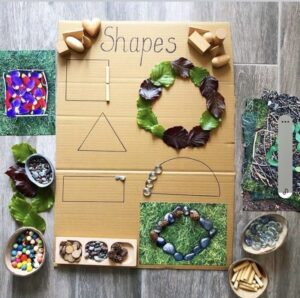
Shapes
Examples of Loose Parts Play Activities
- Building a city with sticks, stones, and wooden blocks.
- Using shells, sand, and water to create a sensory beach scene.
- Sorting buttons, beads, or acorns by color, shape, or size.
- Making a pretend “kitchen” with cratest, pots, and wooden spoons.
- Creating obstacle courses with tires, planks, and ropes.
Examples of Loose Parts to collect
1. Natural Materials
- Pinecones – build towers, pretend animals.
- Sticks – make shapes, letters, or tiny fences.
- Stones/pebbles – counting, patterns, pathways.
- Leaves and herbs – collage, color sorting, pretend food.
- Acorns – counting, stacking, tiny “harvest baskets.”
- Shells – sorting, treasure hunts, sound-making.
- Sand – digging, building, burying treasures.
- Water – pouring, measuring, floating experiments.
- Flowers – pressing, creating scents, art.
- Seeds – planting, sensory bins, counting.
- Spices like cinnamon, anise etc
- Seeds, grains – counting
- Water, ice cubes, snow – sensory play
- Pasta, rice, beans, lentils
- Feathers
2. Recycled / Household Items
- Bottle caps – color sorting, patterns, counting.
- Cardboard tubes – tunnels for toy animals or marbles.
- Egg cartons – sorting, painting, tiny gardens.
- Fabric scraps – scarves, doll clothes, pretend play.
- Buttons – fine motor play, matching, jewelry making.
- Jar lids – stacking, spinning, “coins” in pretend shop.
- Paper rolls – binoculars, tunnels, stacking towers.
- Boxes – houses, cars, ramps for balls.
- Corks – pretend firewood, stacking games.
- Wooden spoons – magic wands, drumsticks, construction tools.
- Cotton balls, sponges, felt
- Small jars, spoons, fennels
3. Loose Art & Craft Materials
- Yarn – weaving, tying, pretend ropes.
- Beads – threading, sorting, making patterns.
- Feathers – pretend wings, sensory touch.
- Pebbles – painting, mandala creation.
- Clay or play dough – modeling, stamping, letters.
- Twine / string – wrapping, tying, building.
- Chalk – outdoor drawing, hopscotch, patterns.
- Paint – painting loose parts, rocks, or sticks.
- Nature rubbings – leaves, bark textures, patterns.
4. Outdoor / Large Loose Parts
- Tires – obstacle courses, tunnels, balancing.
- Planks – ramps, bridges, balancing beams.
- Crates – towers, pretend kitchens, puppet stages.
- Logs – stepping stones, balancing games.
- Rope – climbing, pulling, tying games.
- Water trays – filling, pouring, floating objects.
- Large stones – rock towers, pretend castle walls.
- Leaves piles – jumping, hiding treasures.
- Sticks – building forts, tents, or fences.
- Mud – construction, sculptures, pretend play.
5. Sensory / Learning Loose Parts
- Buttons & beads – color sorting, counting, patterns.
- Natural powders (cinnamon, turmeric) – sensory play.
- Shells & pebbles – texture exploration, treasure hunts.
- Sand + water + small containers – volume play, pouring.
- Small mirrors – reflection, light exploration.
- Magnets – testing which objects stick.
- Clothespins – clipping, counting, fine motor work.
- Scoops & spoons – transferring, measuring, pouring.
- Small jars – storing treasures, potion play.
- Funnels & tubes – water or sand flow experiments.
6. Faith & Bible-Inspired Loose Parts
- Small wooden crosses – building altars or story scenes.
- Mini stones – recreate David & Goliath scene.
- Animal figurines – Noah’s Ark storytelling.
- Fabric squares – pretend prayer cloths or tabernacle curtains.
- Ribbon / string – “Jacob’s ladder” imaginative play.
- Bible story tokens – act out miracles or parables.
- Small baskets – collect “loaves and fishes” for sharing games.
- Paper cutouts – create “fruits of the Spirit” collages.
- Miniature trees / plants – Garden of Eden roleplay.
- Candles (battery-operated) – focus or prayer corners.
Etc
Theres so much to make from loose parts, so many educational games to explore and enjoy for your little ones.
Tips for Parents on how to encourage loose parts play:
- Loose parts can be reused and recycled. Be sure to teach the child to use them wisely and pack them safely after use.
- They can be made from household items like toilet paper rolls, cardboard boxes, empty egg cartons, old spices / herbs wrapping paper etc
- Keep materials safe but versatile—no sharp edges or choking hazards for younger children.
- Rotate loose parts to maintain interest and novelty.
- Encourage children to invent their own rules instead of directing play.
- Outdoor and indoor loose parts can be combined for year-round play.
- Mix indoor and outdoor loose parts for varied play experiences.
- Include faith and nature elements for Natural Nest or devotional play.
- Encourage children to invent rules and stories. it’s about exploration, not outcomes.
- Rotate materials every 2–4 weeks to spark new ideas.
Essentially, loose parts play is about giving children materials, freedom, and space, and then watching their creativity blossom.
Images are from Pinterest.
Shalom,
Following Gods Ways.
Natasha Chetty.